

Podcasts
Making the Move to Self-Funded Health Plans
Mike Rankin and underwriting consultant Scott Swango explain how employers can move from fully insured to self-funded health coverage—and why it might save real money.

In this episode, Mike Rankin of Relational Advisors sits down with underwriting consultant Scott Swango to unpack one of the biggest questions facing employers today: is it time to move from fully insured to self-funded health coverage? Mike and Scott walk through a crawl-walk-run approach to self-funding, starting with level-funded plans and building toward specific and aggregate stop-loss coverage, laser provisions, captives versus consortiums, and pharmacy benefit carve-outs. Along the way, they explain how much more visibility and control employers gain over their claims data and costs once they move past the fully insured “easy button.” It’s a valuable listen for any HR leader or CFO weighing whether self-funding is the right fit for their organization.
Clips
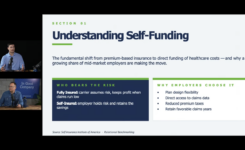
Why Fully Insured Feels Like an “Easy Button”
Time: 1:13
Scott explains why fully insured plans are simple but leave employers with almost no insight into what’s driving their costs.
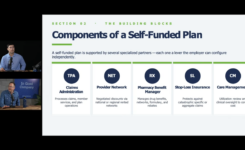
The Crawl-Walk-Run Path to Self-Funding
Time: 2:58
Mike introduces Relational’s step-by-step framework for moving from fully insured to self-funded, starting with a smaller first step most employers don’t know exists.
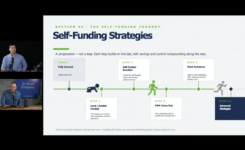
What Is a Level-Funded Plan? (The Middle Ground Employers Miss)
Time: 3:54
Scott breaks down level funding as a low-risk way to dip a toe into self-funding while still getting fixed, predictable costs.
Specific vs. Aggregate Stop-Loss, Explained Simply
Time: 6:28
A clear, practical explanation of the two types of stop-loss coverage that protect employers once they self-fund.
How One Bad Claim Won’t Bankrupt You
Time: 8:05
Scott walks through a real example of how specific stop-loss protection caps an employer’s exposure to a catastrophic claim.
What Is a “Laser” in Stop-Loss Insurance?
Time: 13:43
Scott demystifies one of the most feared terms in self-funding, explaining exactly what a laser is and why it’s not as risky as it sounds.
Captive vs. Consortium: Which Is Right for Your Company?
Time: 15:57
Mike and Scott use a simple Costco vs. grocery-store analogy to explain two different ways employers can pool risk for stop-loss coverage.
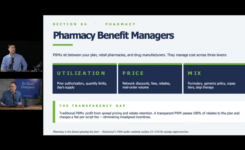
How a Pharmacy Carve-Out Saved One Employer 45%
Time: 18:13
A real-world example of how separating out pharmacy benefit management can dramatically cut one of the fastest-growing cost categories in healthcare.
Transcript
Mike Rankin (0:00 – 0:07) Hi, it’s Mike Rankin with Relational Advisors, and today I’ve got with me Scott Swango. Hey, Scott, how are you?
Scott Swango (0:07 – 0:08) Great. How are you doing, Mike?
Mike Rankin (0:08 – 1:12) I’m doing quite well, thank you. Scott is our underwriting consultant, and I thought it would be helpful to take a few minutes and walk through a subject that’s on a lot of employers’ minds right now if they’re fully insured — this whole idea of “should I go self-funded, and what does that look like?”
I’d say if we zoom out to the big picture, there’s been a much larger trend for companies with 50, 100, 200, 300 employees to now go self-funded, where historically they’ve always been fully insured. So Scott and I are going to walk through some slides here and cover some of the key things to keep in mind as we move forward.
So, Scott, when we talk about the basics — fundamentally, between fully insured and self-insured — how would you describe that?
Scott Swango (1:13 – 1:43) I think fully insured is really just the easiest route to take. It’s a fixed premium, a fixed rate for your members or employees of the plan, and you’re just paying that rate over the course of 12 months. Depending on your size, you get data — sometimes if you’re too small, you do not.
So you don’t really have as much insight or detail into what’s going on, or what you can change to fix it. You just get the renewal at the end of the year, and whatever that increase is, it’s tough to do anything about it.
Mike Rankin (1:44 – 1:46) And the data you’re talking about is claims data, right?
Scott Swango (1:46 – 2:57) Yes, claims data — even just the detail. You might get a very high-level analysis of what happened each month, but there’s no real detail to see what’s driving this, or what changes we can make to improve the plan and find savings. That’s where self-funding really takes hold of that control.
The employer now holds the risk, especially with claims. So instead of just paying the rates, you have the fixed premium, which is a smaller portion of the entire pie, but then you have claims that you’re managing weekly and monthly that you’re paying. And you can actually see the detail — what can we do to help control the cost.
For example, in plan design flexibility, you might have a bunch of members who are only going to the emergency room, which is driving up costs significantly. Maybe there’s a plan tweak we can make to make it more beneficial or cost-advantageous for the member to go to urgent care, or even primary care instead. Finding simple solutions like that can drastically change costs over the long term — I think that’s a huge advantage of going self-funded.
Mike Rankin (2:58 – 3:53) So fully insured is kind of like the easy button. They hit the easy button, and then going into self-funding and tiptoeing into that, there’s more complexity and more moving parts, but also perhaps more opportunity for the employer to save on cost. There are a lot of different components to that, and we’ll touch on some of these as we go forward.
When we look at our strategy for how we help an employer get into it, we like to think of it as a crawl-walk-run approach, because there’s so much that can be done on the self-funding side. But that first step — step one — is what we call level funded, or graded funded. What is a level-funded program? I don’t know that a lot of decision-makers are fully in tune with that option.
Scott Swango (3:54 – 4:36) Level funded is almost a middle ground. On one side, step one is fully insured — the very easy button. But I feel like people think you’re going to immediately go all the way to step five-plus, into these advanced strategies with so many moving parts, but that’s not always the case.
There’s a smaller step in there — step one — called level funded, where you get some of the benefits of self-funding, like more access to claims and a little more flexibility in plan design, or access to some strategies to help save costs. But it’s designed to feel pretty much exactly like fully insured. You get those fixed premium rates.
Mike Rankin (4:36 – 4:39) You know what you’re going to spend in 12 months.
Scott Swango (4:39 – 5:02) It can never get worse — that’s your worst-case scenario. And then at the end of the year, if your plan ran well, depending on the percentage of the claims fund — which is normally about 60 to 70 percent of the total cost — if that section runs well, you can potentially get some amount of that back. Maybe 50 percent, maybe two-thirds.
Mike Rankin (5:02 – 5:03) Depending on the contract.
Scott Swango (5:03 – 5:24) So there’s still shared risk between the employer and the carrier. A lot of times the carrier takes some of that surplus back for those good-running years. But in self-funded, if you were to go over, you now own that risk — so you get to keep all of the savings in those well-running years.
Mike Rankin (5:24 – 5:56) Right. I like to think of level funding — the reason we call it step one is that if you’re there for a couple of years, two or three years, you’ve got a good track record of claims data. Depending on the timing and what’s happening with claims, you’ll be in the best position to negotiate the best stop-loss premium once you go self-funded, as opposed to coming out fully insured with limited data. Stop-loss underwriters get a little skittish with that, and you’re not going to get your best deal at that point.
Scott Swango (5:57 – 6:09) Absolutely. You definitely get more insight. I think that crawl step is a great one to take — to get a feel and an understanding of what it might look like, and then keep building year after year.
Mike Rankin (6:09 – 6:27) Yeah. So sometimes when we say self-funded, we’re really talking about partially self-funded, because we do buy components of insurance to protect the employer. How do those break down? What are the two pieces that the employer purchases?
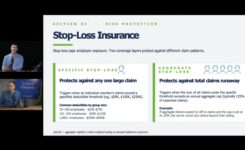
Scott Swango (6:28 – 7:03) The two biggest additional insurances you’re adding to your program are specific stop-loss and aggregate stop-loss. Specific is for each individual member and those high-cost — maybe one-time, maybe ongoing — catastrophic claims.
Let’s say there’s a threshold each employer sets depending on their risk tolerance — say it’s $100,000 for every single member on the plan. After that, if someone on the plan goes to a million dollars in claims, the employer isn’t responsible for the full million.
Mike Rankin (7:03 – 7:03) Right.
Scott Swango (7:03 – 7:22) You buy that protection, so they’re capped at $100,000, and you get reimbursed from the stop-loss for the remaining $900,000. Aggregate is protection for all those claims under that threshold, so as the year goes on, across everyone on the plan —
Mike Rankin (7:22 – 7:24) You have 10 of those stop-loss claims that start to add up.
Scott Swango (7:25 – 7:42) Exactly. If that volatility, or those high claims, start adding up over time, there’s a cap on the total amount — for one person or everyone on the plan — so there are protections in place so it doesn’t completely ruin performance.
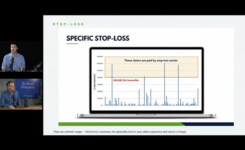
Mike Rankin (7:43 – 7:50) If we were to look at that visually, what are we looking at here with specific stop-loss?
Scott Swango (7:50 – 8:03) The specific stop-loss, remember, is individual protection for each person. On these blue columns, each one represents one particular member of the plan.
Mike Rankin (8:03 – 8:05) One claim, or one member with their claims.
Scott Swango (8:05 – 8:46) Yes. In this example, we have an $80,000 threshold, or cap, for each person. Any time a member with a catastrophic claim goes over that $80,000, it becomes the responsibility of that additional protection you’re buying.
Those numbers can essentially become unlimited depending on the treatment plan or condition. That protection stops that and relieves the anxiety that if one person has a terrible claim, we’re not going to go bankrupt because we can’t pay for it.
Mike Rankin (8:46 – 8:55) And then, what if we have multiple of those specific claims? How do we protect against that?
Scott Swango (8:56 – 9:25) That’s the aggregate — everything under that cap. That $80,000 is what they call your claims fund. A carrier will underwrite this using your claims data to see the trends and what’s expected and needed for that claims fund. Then you add aggregate stop-loss on top of that — typically a percentage over what’s projected, say 10% or 25%.
Mike Rankin (9:25 – 9:34) So it’s kind of a “not to exceed” number. We know that if everything goes to hell in a handbasket, claims-wise, we’re not going to pay over a certain amount.
Scott Swango (9:35 – 10:07) Right — that’s your max liability. It’s the employer’s responsibility to pay those claims, but in a self-funded strategy, it only happens in the worst-case scenario. The carrier will project that your claims are going to run at a certain level, but in the worst case, 25% more than that is your limit. It can’t get worse than that.
Mike Rankin (10:07 – 11:19) It’s interesting you bring that up — it reminds me that a lot of times, a CFO or an employer will compare their fully insured renewal against that worst-case max. What’s important to remember is that worst-case scenario is often only a few percentage points higher than their renewal, but it only happens 2% or 5% of the time. So it’s not really an apples-to-apples comparison. It’s amazing how good the actuarials are at predicting that expected level — of course it can vary, but it’s usually pretty spot-on.
If we break it down further, this is always interesting for employers looking at the question of how to set their specific deductible — should it be $50,000 or $250,000? What are some of the factors that go into that, based on employer size and risk tolerance?
Scott Swango (11:19 – 11:50) As Relational Advisors, we’ll help with that decision, but a lot of it comes down to group size. As a group gets larger, there’s the law of large numbers — more predictability in the claims data, but also typically more cash flow. So depending on the risk tolerance of the company, as the group size or covered employees get larger, they’re able to retain more risk.
Mike Rankin (11:51 – 11:51) Retain more risk.
Scott Swango (11:51 – 12:24) The higher the specific deductible gets, the lower the fixed premium, because more risk is now on the employer to cover claims. That’s a big trade-off. Another factor is the position of the employer — how readily available is that cash flow? Can we afford $100,000 in claims in the first couple of months for one specific person if that first year runs badly?
Mike Rankin (12:24 – 13:00) Right. On that note, some employers just prefer more stability with their risk tolerance. Sometimes we get caught up in the terminology of a specific deductible, but think of it like any insurance — auto insurance. When you have a higher deductible, the premium is lower. It’s about measuring that for the employer, and also looking at the estimated number of claims over that specific deductible, based on their size.
Scott Swango (13:00 – 13:13) That’s where claims data — from doing level funded and getting some insight — helps with that decision too, so you can see over time what’s been happening and project for the future instead of just guessing.
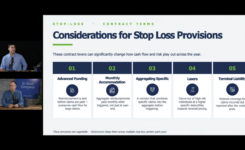
Mike Rankin (13:13 – 13:43) Perfect. When we talk about stop-loss provisions, this is a relatively busy slide — there are five different components, and each one could be its own 30- or 40-minute session. But quickly, on number four — the laser terminology — I think that’s something people have heard before but aren’t totally in tune with. What is a laser in the context of stop-loss insurance?
Scott Swango (13:43 – 14:53) A laser is probably what most employers are scared of — it’s the reason they don’t want to go self-funded, because they’ve heard the buzzword. As we said, specific deductible is for each individual member — let’s say $100,000. But for one individual claimant, there might be a high, ongoing catastrophic condition projected at $500,000 or $600,000.
What a laser does is, instead of a 50% premium increase on the specific deductible to cover that, it targets the one individual and raises their specific deductible. So every member has $100,000, except for that one person, who now has $500,000 or $600,000 — whatever that laser might be. It’s really targeting one person and shifting that risk away from the stop-loss carrier and back onto the employer, who’s now responsible for it. It becomes a factor of what happens with that person the next year, because they could be lasered.
Mike Rankin (14:53 – 14:56) It’s not always 100% probability that they’ll hit the laser.
Scott Swango (14:56 – 15:11) Right — it’s scary to think you’d need an additional $500,000 for one person, but if they end up being fine and their claims stay low, that risk is essentially gone.
Mike Rankin (15:11 – 15:18) And it smooths out the renewals, theoretically, on the stop-loss premium you’re paying too.
Scott Swango (15:19 – 15:24) Right, because if you do the 50% premium increase, it’s only going to keep growing.
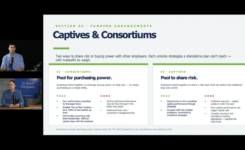
Mike Rankin (15:25 – 15:57) Who knows how long from there. Exactly — got it. So when we talk about purchasing stop-loss insurance — now that we’ve moved on from level funding and we’re looking at self-funding, or partially self-funding — we need to purchase our stop-loss. We can either purchase it on the open market, or through what’s known as a consortium or a captive. What are some of the high-level differences between a consortium and a captive?
Scott Swango (15:57 – 16:15) Both involve pooling together with other like-minded employers to spread risk, so you’re not by yourself. A consortium pools employers together and spreads that risk across the many.
Mike Rankin (16:16 – 16:19) But you’re not buying in like you are in a captive.
Scott Swango (16:20 – 17:03) Exactly. In a captive, you’re buying in — you become an owner of that plan along with everyone else. There’s more involvement from the group to help control costs and manage everyone. It’s more of a team effort versus being on your own, working together to keep the captive healthy and keep everyone’s rates and risk lower.
A consortium can feel more level-funded, especially in a fund-to-max structure. But a captive feels more in tune with self-funding than a consortium does.
Mike Rankin (17:04 – 18:04) I think of a consortium like buying wholesale from Costco — you’re pooling together with other people and buying there. A captive is more like setting up your own grocery store — you pay into that captive with a capital contribution, but then you’re part of the club, so to speak. Some people prefer the consortium route since it doesn’t require a capital contribution but still pools you with others. Others prefer the captive route.
If you’re around 50 to 250 employees, it makes a lot of sense to evaluate both. If you’re 1,000 or 2,000 employees, you can buy directly on the open market, because the benefit of pooling with other employers starts to diminish in that 750-to-1,000-employee range.
Scott Swango (18:04 – 18:12) As your claims get more credible, trends start to level out and it becomes more about the law of large numbers, which becomes pretty consistent over time.
Mike Rankin (18:13 – 20:42) So now we’re in the “run” category, and we turn our attention to pharmacy benefit managers. A lot of people have heard about this recently, because pharmacy costs are now the biggest component of the insurance dollar — usually anywhere from 30% to 40%, especially with biologic drugs and other costly treatments. They’re very beneficial but also very costly, so pharmacy is one of the expense line items growing the fastest.
By doing a pharmacy carve-out — separating the pharmacy purchasing from the PBM, the pharmacy benefit manager, into a more transparent PBM — the rebates, instead of going back to the insurance company, actually come back to the plan and help reduce costs.
In this particular example, an employer went with an independent PBM and saved around 45% of their pharmacy spend. Not every carve-out is a home run like that, but even saving 20% to 30% on 30% to 40% of your spend has a dramatic effect on the overall cost trajectory for that employer. That’s in the run category, and you get there over time once you’ve built out the other pieces.
To wrap up — when you’re fully insured, you renew each year and make a 12-month decision. When you’re self-funding, the decisions tend to play out over a longer period; you’re not trading out the underlying vendors as much, aside from your stop-loss carrier, which is probably the biggest one, and your third-party administrator, or TPA.
If you’d like more information on this or any of the slides, go ahead and put your contact information in. Scott, thank you very much for your time — really appreciate it.
Scott Swango (20:42 – 20:43) Nice job. Thank you for having me.
Mike Rankin (20:43 – 20:43) You got it.